Anatolia is just like a marbling trough. Through thousands of years, hundreds of different civilization with many different colors, sound, rhythm has been composed in this area. They are blended, they get various shapes, but if you look and listen closely you can see the signs of all that great civilizations living in this picture. Turkish dance is one of the most lively and colorful themes of this picture. Its unique rhetoric tells us the stories of central Asian shamans, ancient Anatolian heroes, Islamic traditions and westernization. It tells us the story of people in east-west tensions, humorous coexistence of Islamic tradition and modernity, and peoples from different ethnicities living together in harmony, in its homogenous, coherent and distinctive language.
Story begins in Central Asia which is Turk’s homeland. Most important influence on Turkish dance comes from shamanistic rituals of that time’s Turkish people and other nations around them like China. Thanks to the nomadic Turkish tribes Central Asian culture is preserved and spread in Anatolia. To understand the mystic symbolism in Turkish dances we should have some idea about religions of pre-Islamic Turks. They worshiped the sky god “tengri”. The gods of heaven are not directly appealed to like the spirits of earth and of water but through the intermediary of the spirits of ancestors; which is the aim of a shaman. Dancing is of divine nature, related to the cosmic dance of God or to the dance of a shaman to obtain supernatural results. According to this belief system whole cosmos is a dancing mystery and mysticism recognizes dancing as a symbol of the cosmos. The way going to spiritual experience crosses listening the divine rhythm and sound of the universe and dancing to it to understand it ,to get the bless of the god and to transfer it to their people. Today we see the footprints of the shaman dancing to the drums around a fire in marriage ceremonies, welcoming festival for spring, fertility rites in Turkey. But the answer for why they are dancing so won’t be because they are shaman, but because they’re obliged to do so for custom’s sake, or for the crops, for the cattle, for the happiness and prosperity of the community.
Turks coming from Central Asia, settled on Anatolia, which has been accepted as the bridge between east and west and become homeland to various civilization such as Hittite, Greek, Phrygian, Lydian, Isaurian, Cappadocian, Byzantine.. All this cultures, that’s to say; beliefs, rituals, dances, music, legends are mingled with Turkish culture. According to remnants of that time, there are still scenes from Dionysus ritual’s or Hittite’s musical instruments like clappers or figures in Turkish folk dance which can be traced to pictures drawn on the walls, although it is not very easy to follow.
Islam can be taken as the third important factor influencing Turkish dance. Due to the prudish approach of Islam especially in urban area affected dance culture adversely. Therefore dance developed in two different ways separately in the cities and villages. Peasant dances are more unaffected and distinctive partially because of the fact that they’re isolated regionally, so to say compulsorily independent. Also as Anatolia has its own heritage with many races and religions intermingled, It doesn’t transformed into just an Islamic culture but added Islamic world’s traditions to its own. So the geographic isolation diversity of racial and ethnic influences and cultural traditions has produced rich folklore both in towns and in the rural area.
Without a glimpse to Ottoman palace, Turkish dance history can never be complete. In the sixteenth century, while there were just the first examples of saloon dances in small ceremonies and celebrations of rulers in Europe, There had been harem girls and boys dancing with tens of concubines constituting a local orchestra in Ottoman palace. Dance spectacles of these were the main entertainment of the serai for a long time. “Hippodrome” had been a stage to many kinds of festivals in Ottoman times like it had been in Byzantine’s. The birth of a new prince, the circumcision ceremony, a marriage the accession of a new ruler, or merely the girding on of the sultan’s sword was had been celebrated by spectacular pageants consisting of mock battles between Moslems and Christians, water triumphs, various plays, circus acts, fireworks, horse races, dancing and music there. People living around the palace and in the cities were always a part of these ceremonies so the dance in cities changed and developed with and according to these. However, villagers and their culture, that’s to say their dance and music developed in a different path. They were not really influenced by palace or city life just as they were not very much influenced by Islam, because they were kind of isolated, Anatolian tribes could keep their original traditions..
And westernization comes with the foundation of Republic of Turkey. There happens a lot of change and transition. One of the symbols of these transitions is dance. At that time people are directed from an approach closing dance institutions in the last periods of Ottoman Empire to dance as a necessity for modernization. Atatürk himself encouraged these attempts and politicians to learn how to dance and dance in the ball rooms, ceremonies and celebration for the state. Thanks to these, the classic saloon dances which were performed only by foreigner visiting Turkey and Levantines at that time became available for Turks also and “Republic Balls” became first workshops for these.
Since then, dance and people’s approach to dance have changed very much in turkey like many other things. Dance still constitutes a very important part of the lives of Turkish people as it does in the past. Furthermore, dance is analyzed as a cultural element and learned by every aspect of it when it is learned. Dance schools for Latin dances and contemporary dance are very popular. Specials dance projects are formed combining local elements with the universal.
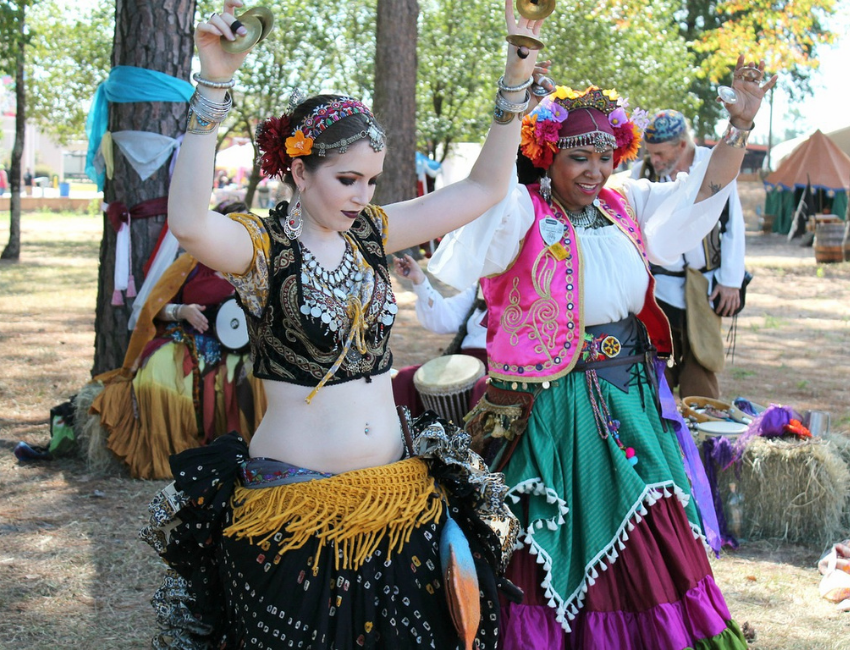
“Belly dance” which is called “göbek dansı” in Turkey is maybe the most famous and popular one of Turkish dances. There are many different cultures which have influenced the development of this style. Esoteric religious rites of Greek and Egypt are some of the ultimate origins supposed for belly dance. But its apparent origins are fertility cults of the ancient world. Whichever the real source of it, belly dance is taken in as a unique dance style, In every step, every movement you can see the hints of its originality and its rich heritage and traditional associations with both religious and erotic elements; because of this mystery, maybe, belly dance is loved by many people all around the world. Oriental dance is uniquely designed for the female body, with an emphasis on abdominal muscles, hip moves, and chest moves. It is firm and earthy, traditionally with bare feet connected to the ground.
It is a dance characterized by smooth, flowing, complex, and sensual movements of the torso, alternated with shaking and shimmy type moves.
The dancers often use some type of rhythm instrument to aid the musicians, or as the sole accompaniment to their dance. Various other items used during dance such as snakes, swords, veils, and candles have magical, protective functions for primitive peoples that can still be found in the folk dances of these countries. Snakes clearly relate to the ancient mystery cults. The snake is a complex symbol which represented both male and female principles, and also immortality in the form of the snake eating its tail.
Belly dance is very popular in Turkey, You can see on TV, in wedding parties and there are many course and dance schools where belly dance can be learned.
Westernization, industrialization, development of roads, mass media affected both traditional arts and every aspect of life in cities and villages. However Turkish Folk dance heritage is so rich and deep rooted that it continues its development both by in its original way and by adding new western elements to it. Some projects are carried out in which folk dance and ballet or folk dance and different styles of music are combined like “Fire of Anatolia” or “Modern Dance Turkey”, which is founded by state opera and ballet. They are originated from the cultural and mythological history of Anatolia, including folk dance figures and folk music collected from nearly every region. In these projects you can see the vivid and passionate Turkish socio-political and cultural life, Anatolian legends, harem to men’s tea-houses, family life to the military, from ancient Anatolia to Ottoman Empire and to the republic and modernity with an approach gping beyond the national borders and confines.
There are so many kids of folk dance in Turkey that we can’t name just one of them as the Turkish folk dance. ”semah”, “zeybek”, “horon”, “halay” and many others which are not listed here are all Anatolian, all Turkish and all living in Turkey. Each of them has a different story. Some of them show us harvest time, some of them welcome spring, some of them imitate a battle scene, tell about a hero, some of them show us the unity of the people. Some are performed only before or in wedding ceremonies. But all tells the stories of many cultures lived and living in Anatolia, tells the story of harmony, discordance, obediance, rebellion, prosperity, conviviality, lament and whatever relating to being human.
Rhythm has always been with people since the beginning of the life with their heartbeats, so dance is. Each race has its own rhythm and each meeting with another rhythm contributes the divine dance of the universe by creating a unique composition. Thanks to its diverse cultural and ethnical heritage with a special share for dance, geography of Anatolia witnesses the most colorful and rich ones.
Some of the Anatolian Dances
Karşılama, hora and salma are the names of the dances which are peculiar to Trakya region, European part of Turkey and also popular in Balkans. Trakya dances are performed with the accompany of two drums and two pipes. Zigoş, one of the most famous dances, is usually danced by six couples standing in two rows. They advanced towards and recede from each other with their backs slightly bent. They begin slowly and softly, the movement becomes violent step by step, to be followed later by crouching movements. There are also sideways steps and embracing gestures.
Zeybek is one of the most well known dances of Turkey,which is found specifically on the Aerean Coast as a characteristic of Western Turkey. It is danced by just one dancer or by several. However even when it is performed by several people, it keeps its solo character as a result of the heroic style of the dance. All dancers follow the movements of others but at the same time they always test the ground and tune their body to the rhythm. Their other leg is in half bent position. They hold their arms outstretched with elbows as high as the shoulders and snap their fingers. Every zeybek is preceded by a slow, introductory part in which the dancer tries leisurely walking steps. This part looks as if the dancers are testing the ground and tuning their bodies to the rhythm. They first walk with the arms at the side, then at shoulder level. It is a dance of solemn, heroic style. The dancers, also called zaybek or efe, wear short embroidered trousers which permit them to kneel. Zeybek can be found in other regiond of Turkey in different styles, sometimes performed with spoons for example. Bengi is also the dance of this region. It is a group dance, representing unity and solidarity like zeybek.
Halay is the most widespread dance all around Anatolia. Nearly every village in most parts of Central Anatolia, Eastern Anatolia and the South has its own halay with its own special tune. Dancers usually place themselves in a line or in a semi circle, holding each other’s hands or shoulders. One dancer acts as their leader. He regulates the steps and directs the figures and sometimes he breaks away from the line and executes solo dances facing the line. There are halays danced by men and women together; however there are halays which are performed by just men or women and they change in manner, style, and figures.
Horon is the name of a group of dances performed in Northern Turkey on the Black Sea Coast. These dances are characterised by alert, tense, shivering movements, the trembling of the entire body from head to foot, or sudden sharp kneeling and springing up with a rebound. The inhabitants of this area are mostly fishermen or men connected with the sea, so not doubt a rough sea shapes their movements and rhythms.
Kaşık Oyunu (Spoon Dance) is the most popular dance in Central Anatolia. Dancers carry in each hand, a pair of varnished wooden spoons, one of which is inserted between thumb and forefinger and the other between the middle and rng finger- in this position they are clicked like castanets. The dancer treads with very small steps in a confined space while undulating the lower part of the body. Another wellknown spoon dance is from Bolu. The dancers start by saluting the onlookers. This salute consists of crouching, touching their spoonsfirst on the ground then on their chins and then on their foreheads. Then the dancers face eacch other in pairs, they approach, recede, kneel and turn.
Bar can be taken as the most remarkable group of dance with about forty variations. They are usually chain dances but there are also several bar for two dancers. The most popular chain variety are the twelve different bar from Erzurum. There are usually five dancers, but there could be many more. A chain bar demands a leader, who stands at the right of the chain.
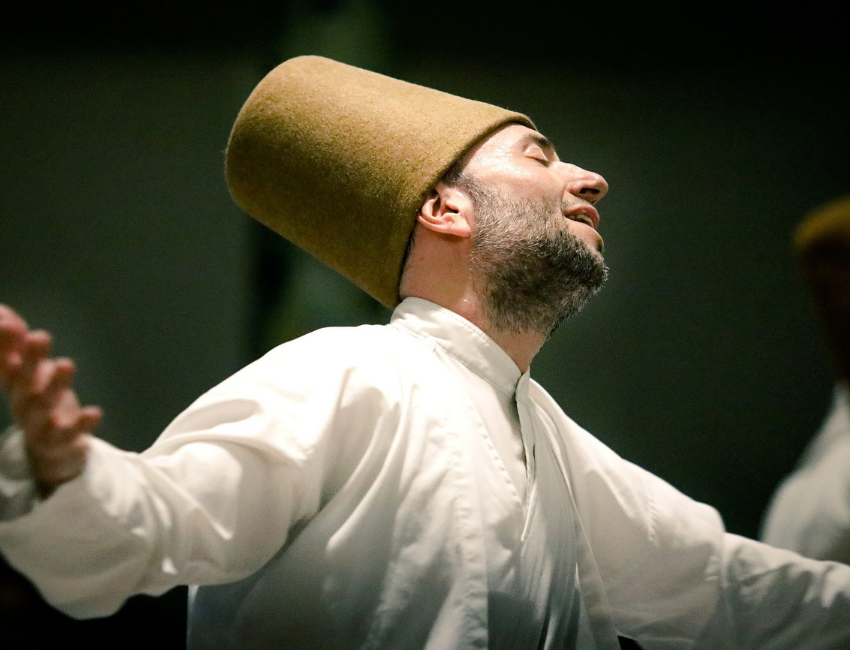
Semah is a quasi-religious social dance of villages belong to nomadic tribes of a sect called Alevite. They were performed in secret indoor meetings called cem before. This dancing, in spite of its spirituel awareness and sacred air usually takes a worldly turn. No doubt these mixed dances have some reference to the suppresion and sublimation of desires. Dancers never hold hands but they face each other and cross them across their chests. The women’s arm movements are more restrained than the men’s, for they never raise their arms higher than their shoulders. They move by pointing the toes with smallfoot movements. There is a sacred place in the hall called çeragtahı where candles are burnt. When a dancer passes this place, he must not turn his back on it, he must face it with his hands crossed on his chest and bow his head. Semahs usually are usually performed in quadrille formation, the dancers facing each other in rows. The dancers shuffle back and forth, breaking through each other counter formation. Semahs usually consist of at least two parts: ağırlama, a slow movement in which men and women mirror each other’s hand and arm movements, and yeldirme, a quick movement in which whirling is a striking feature. There are also hand clappings. Many semahs bear a close resemblance to the folk dances of the same region which is Central and Eastern Asia.
Caucassian dances group is one of the most spectacular dances of Anatolia. As many ethnic group, Caucasian people live and keep their original culture in harmony with all Anatolia. They imitate the natural life in their homeland, tell their stories, love, legends, wars and daily life with their dance with the accompany of their traditional musical instruments named as şık’epşıne(stringed), pondur(accordion-like), doli(percussive), kamalıpşıne(wind). Men are mostly proud and heroic, women are mostly delicate and laydlike. They dance as a group, in couples or solo.
Sources :
“Turkish Dancing” Metin And
“The World’s Oldest Dance” : The Origins of Oriental Dance By Karol Henderson Harding a.k.a. Cala of Savatthi.