Cappadocia (Kapadokya)
In central Anatolia, to the south of Ankara, Turkey’s capital, lies a region described picturesquely as looking like the lunar surface. Even the most blasé traveller will gasp in wonder at the scenery around Ürgüp. Here, aeons ago, Mount Erciyas, a 13,000 foot peak, ever to be seen as a snow-covered backdrop, erupted and covered the region with volcanic ash and lava. Thousands of years of erosion have weathered this material into myriads of cones and pinnacles which, like so many fingers stretching heavenwards, rise from the valleys. The Turks call these pinnacles fairy chimneys. Many of them reach a height of more than 100 feet.
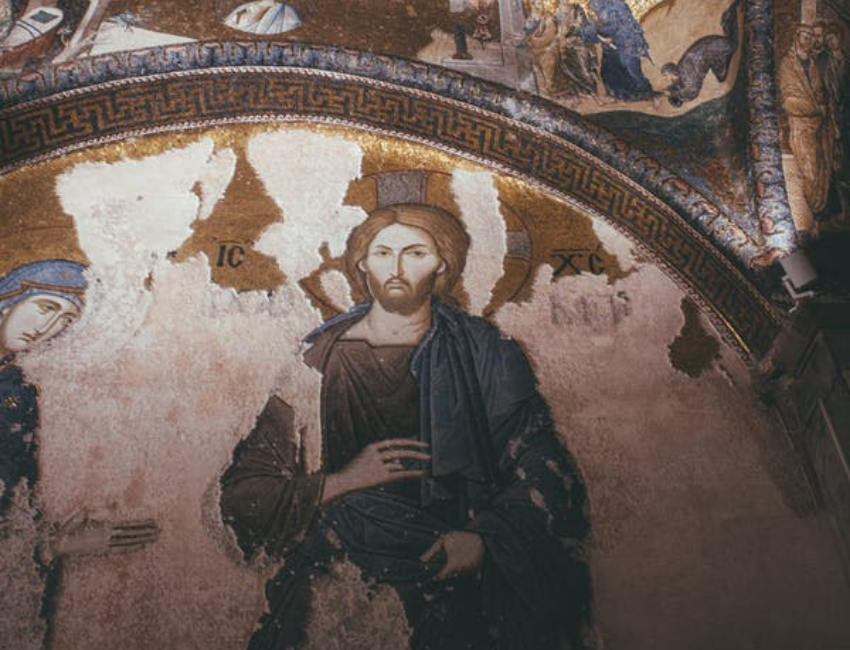
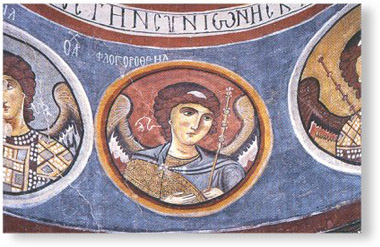
However, it is not only for the landscape that the journey to Ürgüp is memorable. The rock has been scooped out from hundreds of the chimneys and their interiors made into churches, monasteries and cells. In the early days of Christianity, Kayseri, ancient Caesarea, 60 miles to the east of Ürgüp, was the capital of the Roman province of Cappadocia and a great center of Christianity .The Christians, when persecuted by pagans, fled to Ürgüp. Here, they found that the soft tuffa rock could readily be worked and so they hollowed out hiding places. After settling, these people became more ambitious and started to scoop out the interior of larger pinnacles. They left columns and arches, domes and drums, and in this manner built their churches. Although it is the architecture of the churches which first catches the visitor’s eye, what holds and retains it are the brilliant frescoes which cover the interior of these churches. Most were painted between the 8th and 12th centuries. The painters used colors derived from local rocks and herbs. Because the frescoes are in the dark and the climate is dry, the colors are as fresh and vivid today as when first painted.
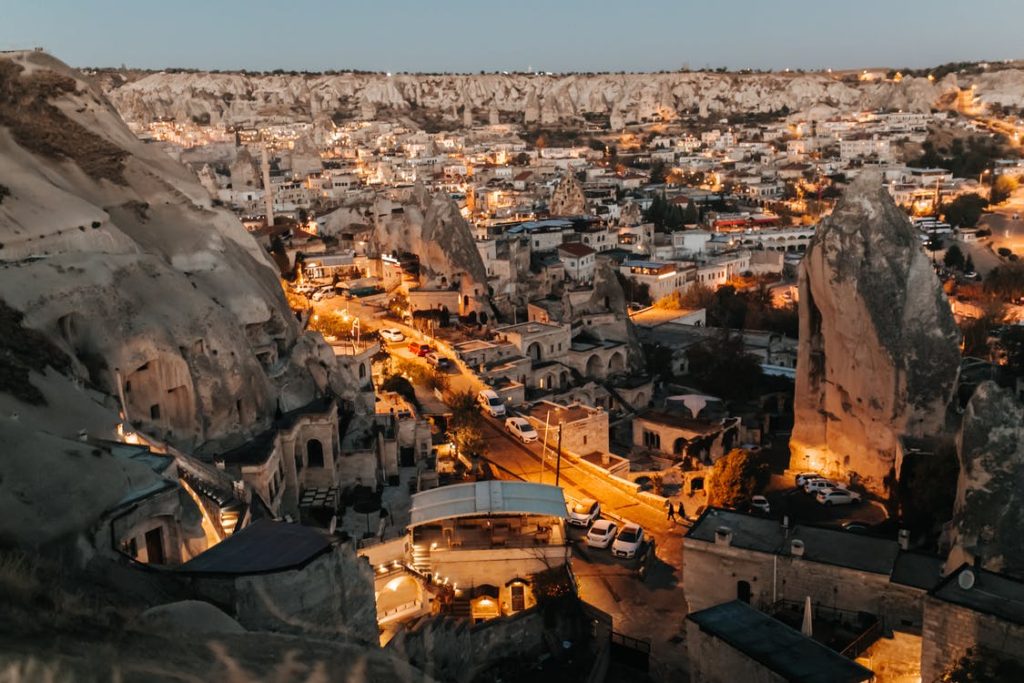
Many of the churches are situated in the region called Göreme and, fortunately for the visitor who is pressed for time, half a dozen of them are within five minutes walk of one another. These, with respect to both their architecture and frescoes, are truly representative of the region.
The Tokalı Kilise (Buckle Church) is the largest in the group. The naves, transepts and apses are gouged out of rock, and there is even a crypt. The church is magnificently frescoed with narrative scenes from the New Testament. There are many paintings of the Saints, especially Saint Basil, who was the most popular saint in Cappadocia. The dominant color of the paintings is a rich but somber blue.
The Çarıklı Kilise (The Church of Sandals) has the foot-prints of Christ in the transept. Then there is the Karanlık Kilise (The Dark Church) lit by only one tiny window. Attached to this church is a monastery; chiselled out of the rock are a refractory table with seats around it. There is also a wine press and tunnels which could be blocked off by huge round stones if the monks were forced to flee.
The entire Ürgüp region is full of such treasures. Pinnacles, cones and turrets were not the only hiding places of the Cappadocian Christians. Many of them literally went underground -they hid in underground cities. Thirty miles south-west of Ürgüp is the most fascinating place to visit in the whole of Turkey. Here are the underground cities of Kaymaklı and Derinkuyu. The visitor will be shown-and it is essential to have a guide or you will get lost-a regular warren of passages which descend to a depth of more than 100 feet. Each city, consisting of several levels, is divided into a number of sub-sections. These can be sealed off by huge round stones similar to those seen at the Karanlık Kilise in Göreme. In these underground cities, where many thousands lived, are sleeping quarters and kitchens; wells and ventilation shafts; wine presses and millstones and a number of churches. Incised on the walls of the churches are Christian crosses. It is thought that during the 1st to 3rd centuries Christians from around Kayseri fled to the underground cities of Kaymaklı and Derinkuyu.
For you who are not exhausted and would like to leave the relatively beaten track and explore a primitive Turkey which is rapidly disappearing, drive for a further two hours west to Ihlara. Here, in an idyllic sylvan region, quite different from that of Ürgüp, are a group of rock churches carved out of the precipitous sides of a ravine through which flows a gentle stream. Architecturally, the churches of Ihlara are much more simple than those of Göreme. However, their interiors are also covered with superb frescoes, some of which are of a much brighter color. The churches of Ihlara cannot be found without the help of a guide. Ürgüp is 170 miles from Ankara by way of Nevşehir. The roads are excellent; the trip pleasant. Alternatively, the visitor can fly or travel by road to Kayseri.
Myra (Demre)
It is associated with Santa Claus. Father Christmas -alias Santa Claus, or to give him his proper name -Saint Nicholas – was born late in the third century in Patara, forty miles from Demre. Little is known of the life of Saint Nicholas, but it has been discovered that he made a pilgrimage to Palestine and on his return lived at Demre (ancient Myra). Eventually he became Bishop of Myra, where he died in 342 on December 6. The ruins of the St.Nicholas Church can be visited today in Demre. It is an interesting place to visit, not only for its historical importance to the Christian world, but also for a most unusual sight -the ancient portion of the church is now entirely subterrannean. The dust and debris of centuries have raised the level of the land as surely as the silt-carrying river has filled in the harbor and cut the town off from the sea. Demre, being on the balmy southern coast of Turkish Turquoise Riviera, has a long swimming season as well as other historical sites to attract tourists. Demre is just a two-hour drive from Antalya, itself only 75 minutes flight from Istanbul.
Sumela
(The shrine dedicated to Virgin Mary on the Black Sea mountains)
Sumela
(The shrine dedicated to Virgin Mary on the Black Sea mountains)
Archaeologists have found Bronze Age settlements on the Black Sea, notably near the old deltas of the rivers and near Samsun and Sinop. Some of the shards relate to similar finds in the Troad. Thus there appears to have been a natural, early trading connection between the Black Sea and the Aegean peoples. A thousand years later Sinop was the port for the Hittites. In Hellenistic times the southeastern shores of the Black Sea were controlled by the Pontic kings, many of whom were named Mithridates. When the Fourth Crusaders captured Constantinople (1204), the Comneni ruler escaped to Trebizond (note that the spelling of this city has several variations; the Turkish form is Trabzon) where he set up his court, and where the Byzantine Empire held out against the Ottomans for eight years after Constantinople was captured.
Not many people know that in the Pontic mountains of Turkey, there is on a ledge high above a wooded valley an enormous, white monastery. It was a functioning monastery until 1923, when the Pontic Greeks abandoned the building and it was largely forgotten. It is now a major tourist attraction to those visiting the Black Sea Coast, with 7,000-8,000 visitors per year. The monastery is in the Zigana Mountains, with rivers rich in fish especially in trout, mountains rich in game and forests decorated with wild rhododendron and rose bushes.
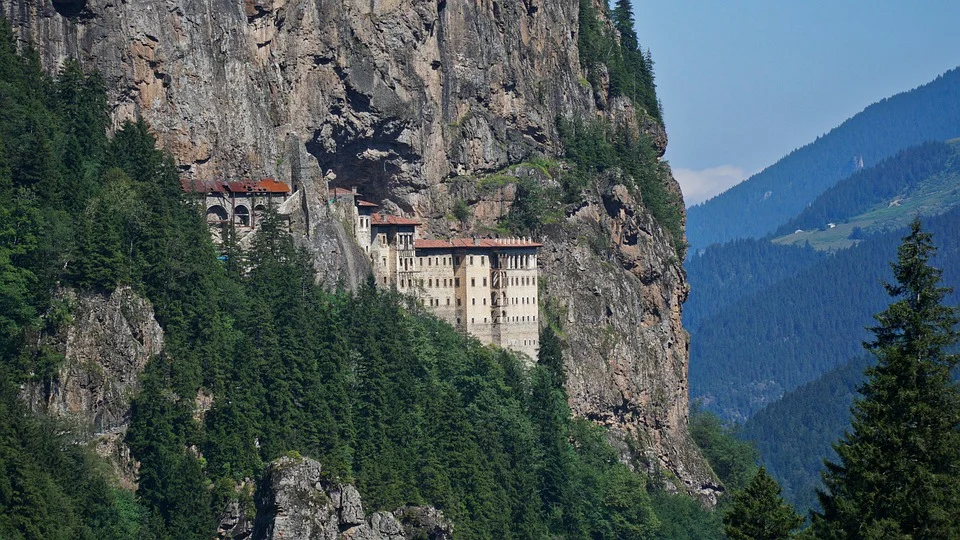
The story told of the founding of this monastery, which became in Byzantine times, the largest and most important one in Asia Minor, is interesting. Two Greek monks, Barnabas and his nephew Sophronius, had a dream in Greece in which the Virgin appeared to them and directed them to take her sacred icon painted by St Luke from Athens and to come and found a monastery in the Pontic Mountains. They took a ship to Trabzon, came up into the mountains and found that this spot agreed with their vision. Here, they built a sanctuary for the icon in one cave and turned the others into cells for monks. They called the shrine the Panaghia tou Melas, or the Virgin of the Black Mountain, a name which became Panaghia soumelas -in the local dialect just Soumela or Sumela. (To the people of the area today it is often more simply known as Meryemana, the Turkish name for Virgin Mary.)
Gradually, the monastery developed, though nothing remains of these early foundations. It was often helped by its isolation to escape from the controversies of the times. >From the 13th century, the Comneni, the Emperors of the independent Byzantine Empire of Trebizond, patronized and enriched it. Alexios III Komnenos had himself crowned there in 1350; this was the golden age of Sumela. The Comneni Empire finally fell to Mehmet the Conqueror in 1461. Nevertheless, the monastery was left in peace and the monks were granted a ”firman” (imperial decree) giving them rights to their land and property and incomes, and exemption from paying tribute. Various Sultans even presented gifts to the monastery. In 1740, Sultan Mahmud I gave the order for the renovation of the frescoes which are the ones we see today in the church. Extensions and repairs were still being made in 1860. At the end of the 19th century there were reported to be about 100 monks, and every week a caravan of mules came up from Trabzon with provisions. A small Romanesque church, St Barbara was also built below the monastery near the end of that century. But World War 1 and the troubles and famine and insecurity which followed it were finally to bring an end to the monastic life which had lasted fifteen centuries. In 1923, the monks fled, hiding their precious icon and other relics in the Church of St Barbara. One monk, Ambrosias, was allowed to return in 1931 to retrieve these relics and take them back to Greece.
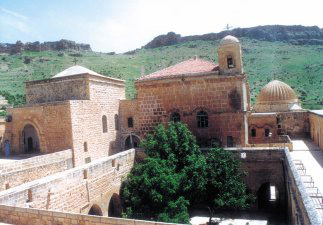 | 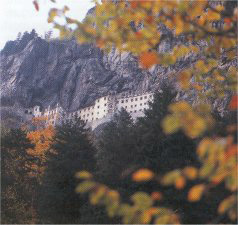 |
Monestry, Trabzon
Last House of the Virgin Mary
St. John, to whom Jesus entrusted the care of his mother, came to Ephesus in the middle of the first century, where he preached, wrote and died.
Although there is no conclusive proof in the New Testament as to where Mary died, it is thought that John brought Mary with him and she lived in her peaceful retreat atop the 1,300-foot-high Nightingale Mountain, near ancient Ephesus, 50 miles south of the port city of Izmir on the Aegean Sea. Many historians and the Roman Catholic Church authorities are convinced that this place was Mary’s last resting home.
Mary’s House, a humble Byzantine edifice that is noteworthy for its quiet dignity, was first restored in 1950. The Catholic Church has blessed the site as a sacred place of pilgrimage. On July 26, 1967, His Holiness Pope Paul VI expressed his faith in it by praying here before the altar.
Last House of the Virgin Mary
St. John, to whom Jesus entrusted the care of his mother, came to Ephesus in the middle of the first century, where he preached, wrote and died.
Although there is no conclusive proof in the New Testament as to where Mary died, it is thought that John brought Mary with him and she lived in her peaceful retreat atop the 1,300-foot-high Nightingale Mountain, near ancient Ephesus, 50 miles south of the port city of Izmir on the Aegean Sea. Many historians and the Roman Catholic Church authorities are convinced that this place was Mary’s last resting home.
Mary’s House, a humble Byzantine edifice that is noteworthy for its quiet dignity, was first restored in 1950. The Catholic Church has blessed the site as a sacred place of pilgrimage. On July 26, 1967, His Holiness Pope Paul VI expressed his faith in it by praying here before the altar.