
Description
Visit Mazar of Mevlana Jalaluddin Rumi & Semsi Tebrizi & Sheikh Sadrettin & Atishbaz Wali
Daily Konya Tour from Istanbul
Tour Programme
- Early in the morning we pick you up from your hotel or apartment in Istanbul and transfer to the airport
- You will take a 1 hour flight to Konya
- Upon arrival to Konya , you will be welcomed by our representative at the airport and we will transfer you to the town to meet your professional government licensed Islamic History expert tour guide
- Visit Mevlana Jalaluddin Rumi Tomb and Dervish Lodge
- Visit Sems-i Tebrizi Tomb
- Visit Ibn Ul Arabi’s Son Sheikh Sadrettin Tomb
- Mazar of Hazrat Atishbaz Wali –
Hazrat Mevlana Jalaluddin Rumi ‘s Cook - Lunch in Konya is also complimentary with one soft drink and water
- Visit Madrasah in Konya which was formerly used to teach Qoran to children and local people
- After wonderful and most comprehensive Konya Islamic Tour we transfer you to Konya airport and you take a flight back to Istanbul with sweet lifetime memories of Konya
- Upon arrival to Istanbul , our staff is welcoming you at the airport and we transfer you back to your hotel or apartment or we can drop you wherever you like .
Daily Konya Tour Includes :
- Pick up and Transfer from your hotel or apartment to Istanbul airport or Sabiha Gokcen airport
Istanbul Konya flight ticket - Transfer from Konya airport to city center
- Private Professional Government Licensed Islamic & Ottoman History Tour guide in Konya
- Deluxe Vehicle in Konya for all day
- Any entrance fees or parking fees
- Lunch in Konya with one soft drink and water
- Transfer back to Konya airport after the tour
- Konya – Istanbul Flight ticket
- Drop back Transfer from Istanbul airport or Sabiha Gokcen airport back to your hotel or apartment in Istanbul
24 /7 Local assistance
Bazaar Turkey – Les Arts Turcs Art Studio
Alemdar Mh. Incili Cavus St.
No: 19 Floor : 3 (Behind The Underground Cistern)
Sultanahmet 34110
Istanbul, Turkey
Contact : Mr. Alp or Mr. Nurdogan ( Phone : +90 544 220 10 22 )
E-mail : info@bazaarturkey.com
Google Maps : https://goo.gl/maps/uXuyRmELZsx
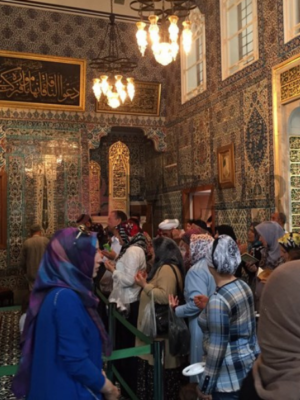
Photos From our Daily Konya Mevlana Rumi Tour
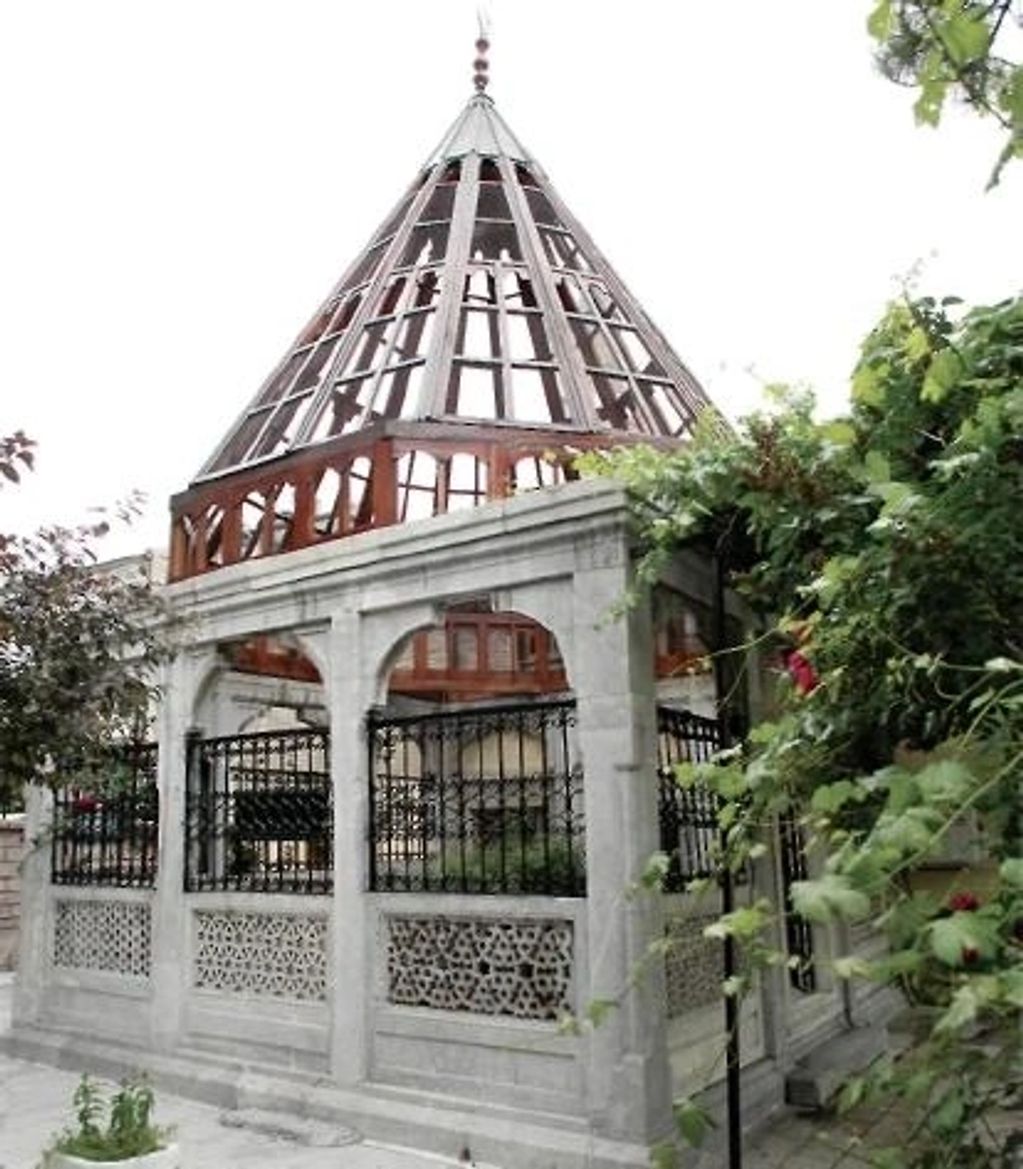
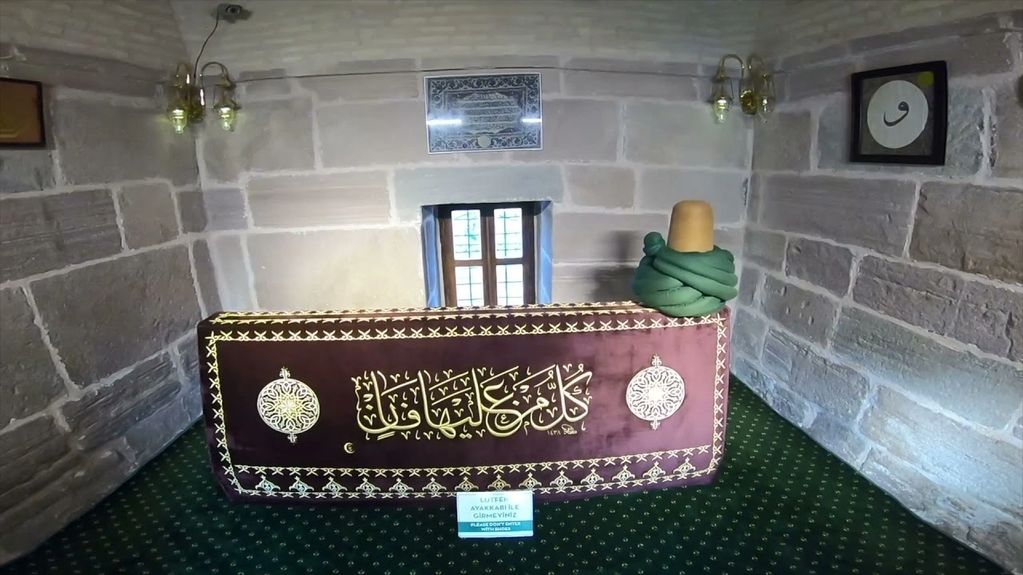
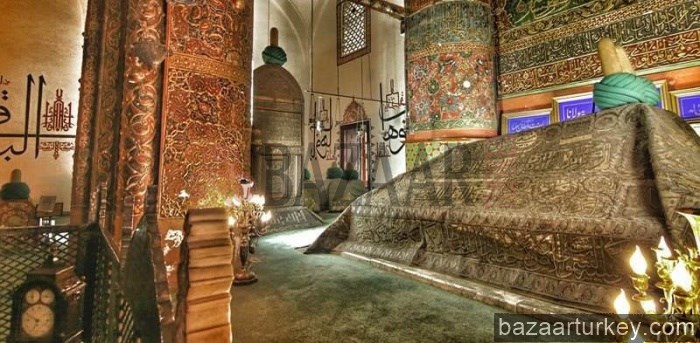
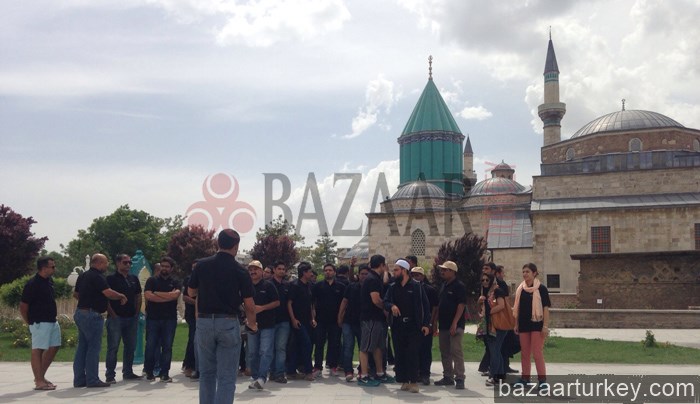
About Konya
Konya is a city in Central Anatolia in Turkey which has protected its name for centuries. Legend says that Perseus killed a dragon that had been ravaging the town. The people set up a special monument to honor him, a stone obelisk with an icon of Perseus carved in it. This event gave the city it’s name, Ikonyon, Ikonyum, Iconium.
However, among Muslims, another legend is told. Two dervishes, friends of Allah, were making an excursion through the skies from the far away countries of Horasan toward the west. When they flew over the lands of central Anatolia, one asked the other, “Shall I land?” (“Konayim mi?”). The other answered, “Sure, land.” (“Kon ya!”) So, they landed and founded the city of Konya.
Archaeology shows that the Konya region is one of the most ancient settlements of Anatolia. The results of excavations in Catalhöyük, Karahöyük, Cukurkent and Kucukoy show the region was inhabited as far back as the Neolithic Period (Late Stone Age) of BC 7000. Other settlers of the city before Islam were; the Calcolitic Period (Copper Age) civilizations, Bronze Age civilizations, Hittites, Frigians, Lidians, Persians, Romans and finally Byzantines.
The first exposure of the city to Islam happened during the time of the Caliph Muaviya. Later, attacks made by Arabic Muslims, whether Emevi’s or Abbasi’s, yielded no results. Konya’s real meeting with and adopting of Islam began some time after the victory of Seljuks at Malazgirt in 1071, in the time of Kutalmisoglu Suleyman. The attacks of the Crusaders from 1076 to the end of the 12th century could not wrench the city from Islam.
Konya was the capital of Seljuks between 1071 and 1308. In 1220 Alaaddin Keykubad I repaired the city wall and decorated them with towers. But the city has been the site of a power – struggle between the Seljuks, Karamanoglu’s, Mongols, and Ilhan’s and it changed hands a few times. In the time of Fatih Sultan Mehmet, in 1466, Konya joined the lands of the Ottoman Empire. The first general census was made by the sultan and repeated in the time of Bayazit II, Kanuni Sultan Suleyman, and Murad III.
In the time of Kanuni Suleyman, the city, which had been named as Karaman ili, reached the status of statehood. The borders of the Karaman state, which included the regions of Larende (Karaman), Seydisehri, Beysehri, Nigde, Kayseri (Cesarea), Aksaray, Maras, Elbistan, and Bozok, were reduced when Maras became its own state and Bozok was added to another state.
Konya was affected by the Celali Rebellion. This rebellion was an outcome of the instability in the Ottoman government and land orders in the Ottoman army was defeated by the command of Ibrahim Pasa, Grand Vizir of Sultan Suleyman, in the Battle of Konya.
The borders of the province of Konya, which was set up in 1867, included Nigde, Isparta, Icel and Teke Sanjaks. In the same year, the city was affected by a big fire and in 1873 suffered a serious famine.
In the 19th century the city appeared shabby and neglected and the city walls were in ruins and even the mosques were in terrible conditions. Many of the more recent houses were made of bricks and their lifespan was not more than 100-150 years. Commercial activity was slow. But at the end of the century, in 1896, after the railway toEskisehir was opened, commercial activity was revived. After 1902, farming with machines developed. The period of sultan Abdul Hamid II was a productive one for Konya. Transport, education and restoration works flourished the city as they did in the whole of the country.
The First World War caused the decrease of manpower in Konya and throughout the country. During the occupation of Anatolia by the Allies, Konya’s railway station was run by the British (January 1919). The Italian powers which occupied the city in April 1919, left the city in March 1920 during the Independence War led by Atatürk.
The most important place to visit in Konya is Mevlana’s Mausoleum, the mystic poet on the way of sufism and the founder of the Whirling Dervish order. Apart from that there is Karatay Medrese, which was a theological school used as tiles museum today, Alaaddin Keykubat Mosque from 12th century and Ince Minare (Thin Minaret)Mosque.
Another interesting attraction in Konya is the Tropical Butterflies Park which was opened in July 2015. Being the first of its kind in Turkey, the Park provides shelter to 6,000 butterflies of 15 different species, as well as 20,000 tropical plants.
About Museum
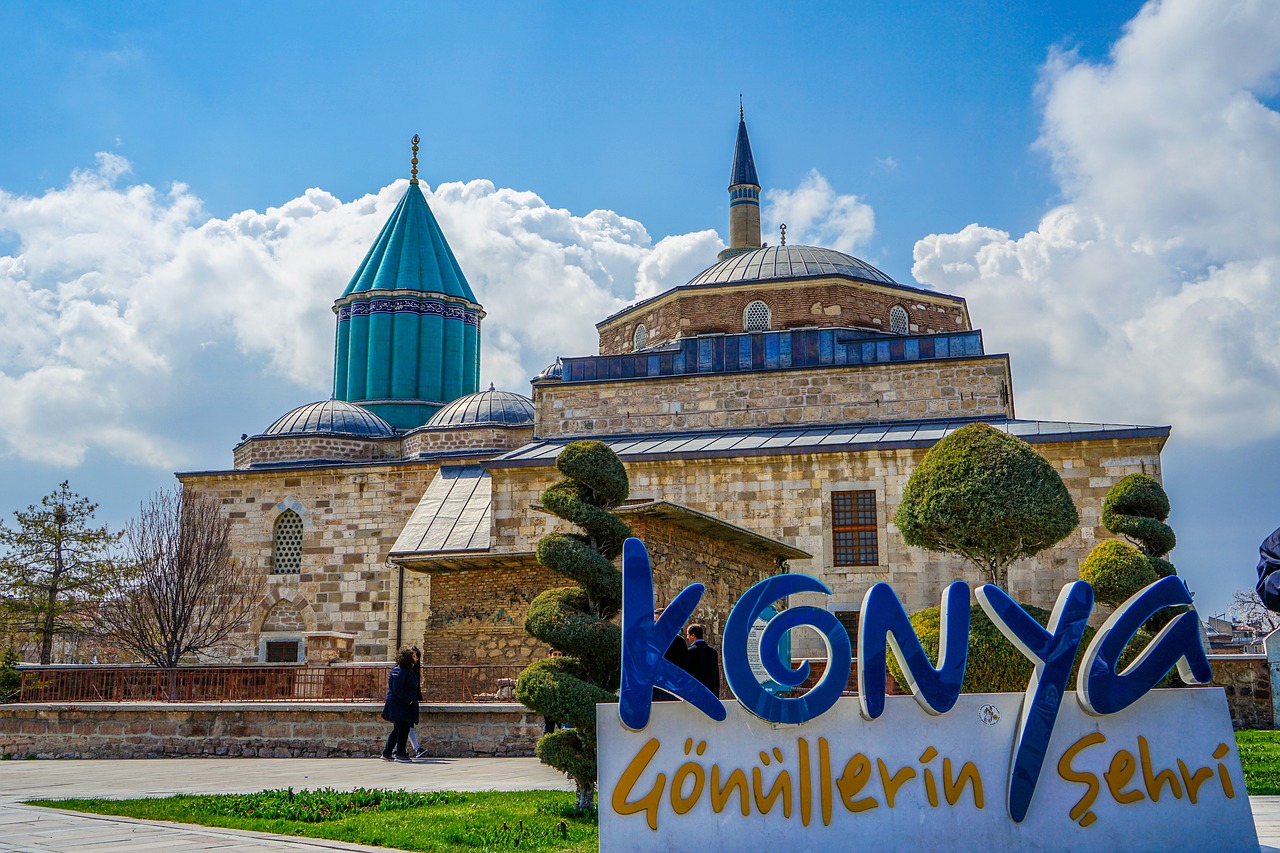
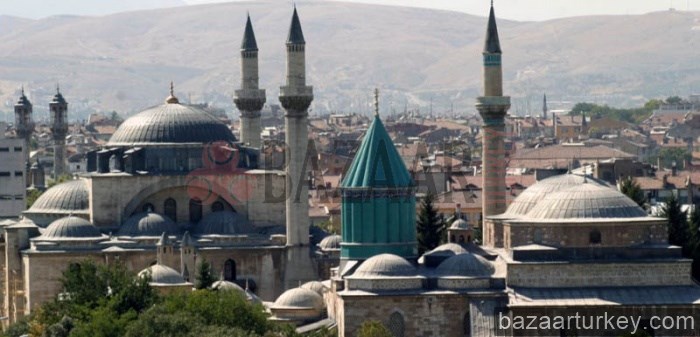
The Mevlâna Museum, located in Konya, Turkey, is the mausoleum of Jalal ad-Din Muhammad Rumi, a Persian Sufi mystic also known as Mevlâna or Rumi. It was also the dervish lodge (tekke) of the Mevlevi order, better known as the whirling dervishes.
Sultan ‘Ala’ al-Din Kayqubad, the Seljuk sultan who had invited Mevlâna to Konya, offered his rose garden as a fitting place to bury Rumi’s father, Baha’ ud-Din Walad), when he died on 12 January 1231. When Mevlâna died on 17 December 1273 he was buried next to his father.
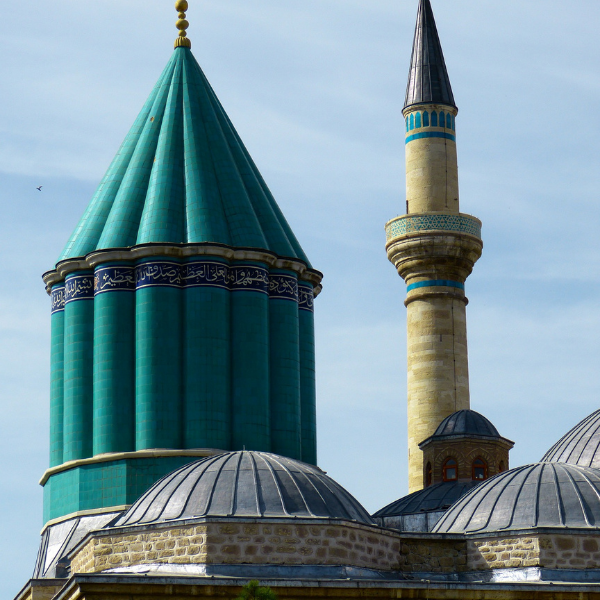
Mevlâna’s successor Hüsamettin Çelebi decided to build a mausoleum (Kubbe-i-Hadra) over his grave of his master. The Seljuk construction, under architect Behrettin Tebrizli, was finished in 1274. Gürcü Hatun, the wife of the Seljuk Emir Suleyman Pervane, and Emir Alameddin Kayser funded the construction. The cylindrical drum of the dome originally rested on four pillars. The conical dome is covered with turquoise faience.
However several sections were added until 1854. Selimoğlu Abdülvahit decorated the interior and performed the woodcarving of the catafalques.
The decree of 6 April 1926 confirmed that the mausoleum and the dervish lodge (Dergah) were to be turned into a museum. The museum opened on 2 March 1927. In 1954 it was renamed as “Mevlâna Museum”.
One enters the museum through the main gate (Devisan Kapısı) to the marble-paved courtyard. The kitchen of the dervishes (Matbah) and the Hurrem Pasha tomb, built during the reign of Süleyman the Magnificent, are located on the right side. On the left side are 17 dervish cells lined up, covered with small domes, and built during the reign of Murad III. The kitchen was also used for educating the dervishes, teaching them the Sema. The sadirvan (washing fountain) in the middle of the courtyard was built by Yavuz Sultan Selim.
One enters the mausoleum and the small mosque through the Tomb gate (Türbe Kapisi). Its two doors are decorated with Seljuk motifs and a Persian text from mollah Abdurrahman Cami dating from 1492. It leads into the small Tilavet Room (Tilavet Odası) decorated with rare and precious Ottoman calligraphy in the sülüs, nesih, and talik styles. In this room the Koran was continuously recited and chanted before the mausoleum was turned into a museum.
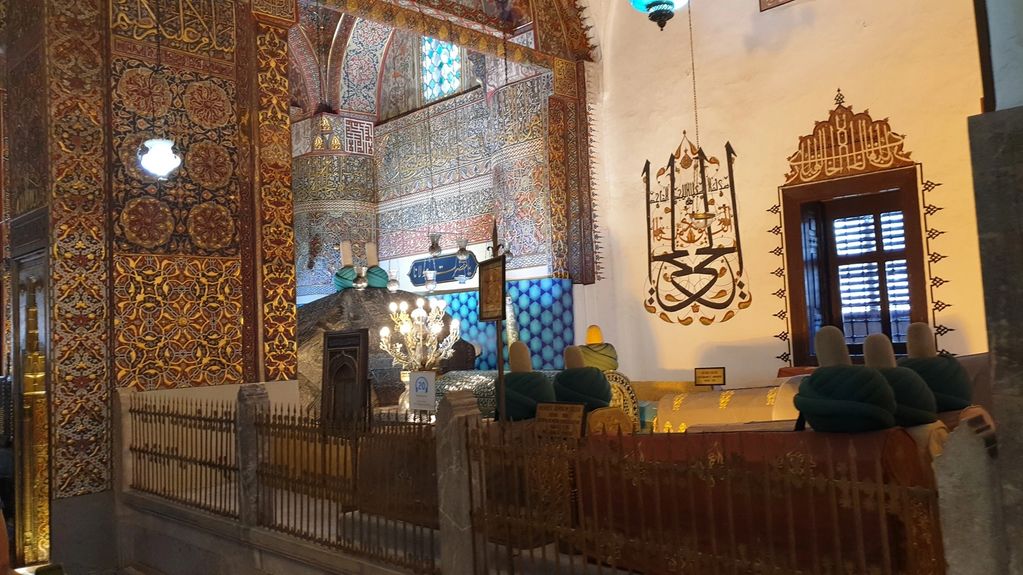
One enters the mausoleum from the Tilavet Room through a silver door made, according to an inscription on the door, by the son of Mehmed III in 1599. On the left side stand six coffins in rows of three of the dervishes (Horasan erler) who accompanied Mevlâna and his family from Belkh. Opposite to them on a raised platform, covered by two domes, stand the cenotaphs belonging to the descendants of the Mevlâna family (wife and children) and some high-ranking members of the Mevlevi order.
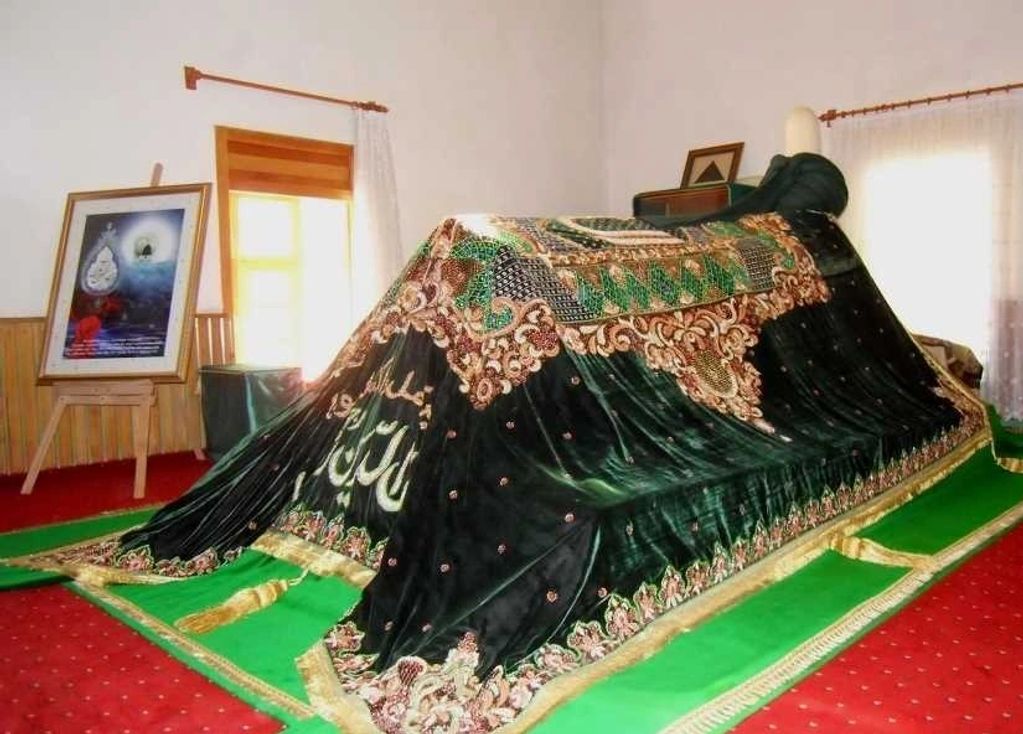
The sarcophagus of Mevlâna is located under the green dome (Kibab’ulaktab). It is covered with brocade, embroidered in gold with verses from the Koran. This, and all other covers, were a gift of sultan Abdul Hamid II in 1894. The actual burial chamber is located below it. Next to Mevlâna’s sarcophagus are several others, including the sarcophagi of his father Bahaeddin Veled and his son Sultan Veled. The wooden sarcophagus of Mevlâna dates from the 12th century now stands over the grave of his father. It is a masterpiece of Seljuk woodcarving. The silver lattice, separating the sarcophagi from the main section, was built by Ilyas in 1579.
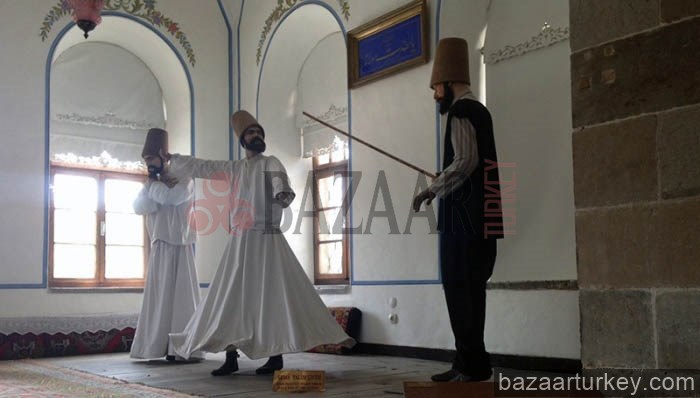
The Ritual Hall (Semahane) was built under the reign of Süleyman the Magnificent at the same time as the adjoining small mosque. In this hall the dervishes used to perform the Sema, the ritual dance, on the rhythm of musical instruments such as, the kemence (a small violin with three strings), the keman (a larger violin), the halile (a small cymbal), the daire (a kind of tambourine), the kudüm (a drum), the rebab (a guitar) and the flute, played once by Mevlâna himself. All these instruments are on display in this room, together with an ancient Kirşehir praying rug (18th century), dervish clothes (Mevlâna’s included) and four crystal[citation needed] mosque lamps (16th century, Egyptian Mameluk period). In this room one can also see a rare Divan-i-Kebir (a collection of lyric poetry) from 1366 and two fine specimens of Masnavis (books of poems written by Mevlâna) from 1278 and 1371.
The adjoining small mosque (Masjid) is now used for the exhibition of a collection of old, illustrated Korans and extremely valuable prayer rugs. There is also a box, decorated with nacre, containing the Holy Beard of Hz. Muhammad (SAV).

Reviews
There are no reviews yet.