by Asli KAYABAL
At the top of the bill leading down to the Galata Tower in Istanbul
is a Mevlevi dervish lodge, the Galata Mevlevihane Galip Dede Caddesi is
a street known for its many shops selling musical instruments, and here
a stone archway leads into a tree filled courtyard in which this
historic building stands hidden from the street. Today the building
houses the Museum of Divan Literature and a collection of musical
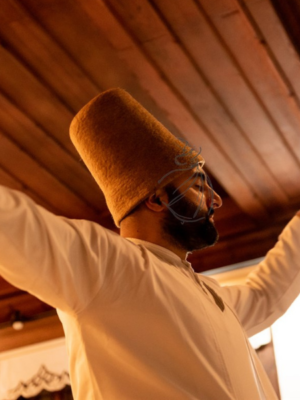
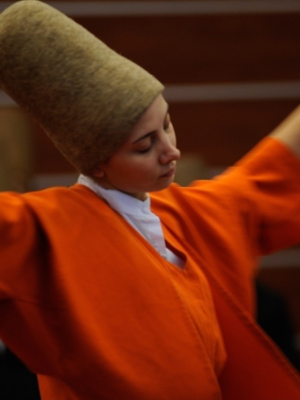
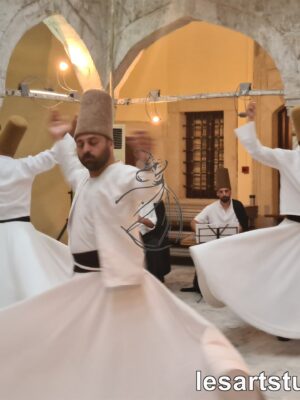
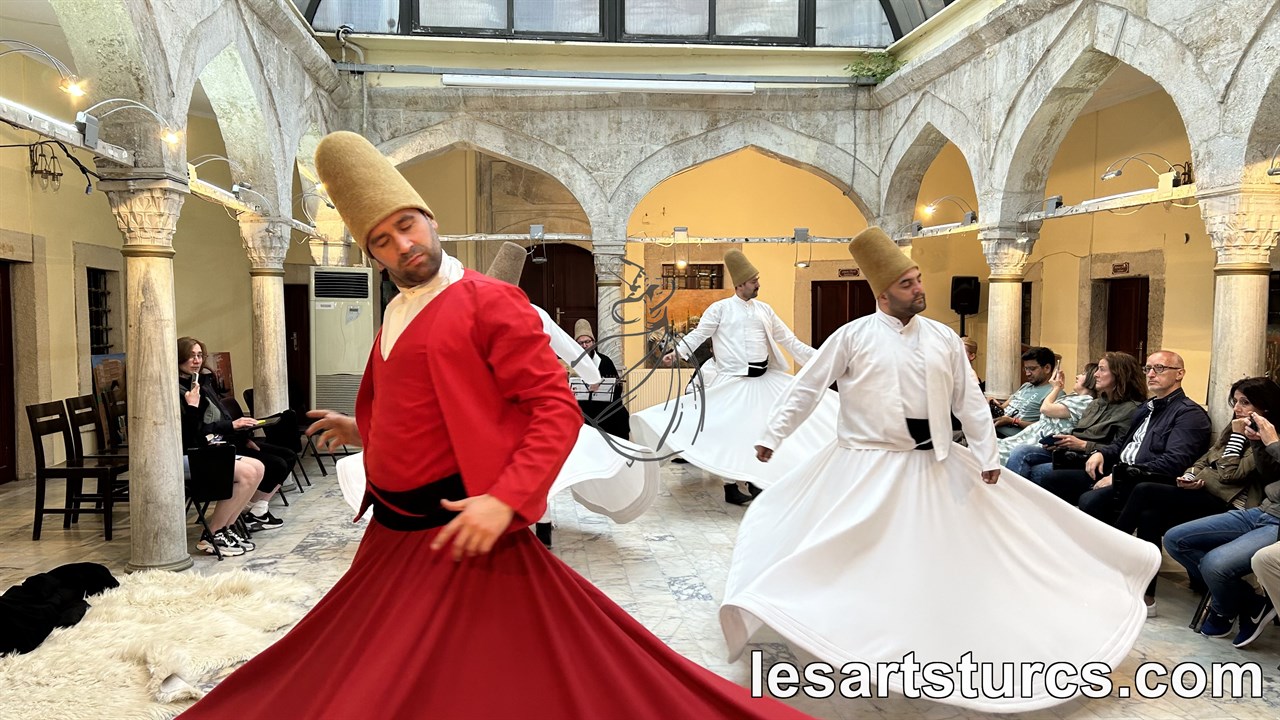
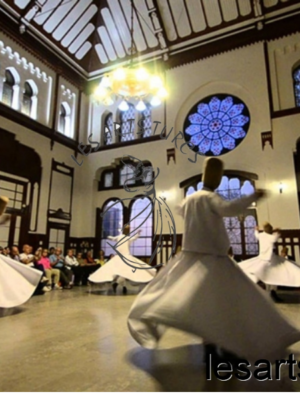
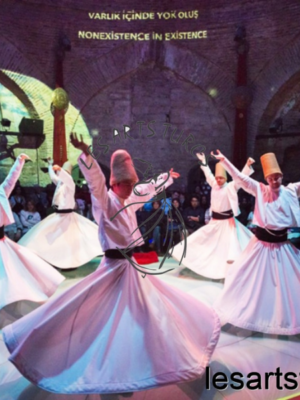
instruments, but the dervish ceremonies known as sema are still
sometimes held here, and then this quiet spot is crowded with visitors.
The Mevlevi mystic order was established by Sultan Veled, son of the
13th century Islamic philosopher Celâleddin-Rum". One of the foremost
Sunni mystic orders, Mevlevi philosophy takes the union between God and
the universe as its starting point, and believes that everything which
exists is in fact. an aspect of God. Where Mevlevi thought differs from
that rationalism is the belief that not reason but divine love, ask, is
the way for human beings to attain truth. Ask is profound love and
yearning for God in the human essence.
Another feature of the Mevlevi order is that it was the first to make
music a central part of religious practice. The ney, kudum and later
instruments such as the tambur were used in Mevlevi ceremonies. It is
said that at gatherings Mevlânâ Celâleddin-i Rum" recited poetry
and engaged in the whirling dance known as the sema. Following his
father's death, Sultan Veled laid down specific principles for the sema
and other practices, thereby laying the foundationss of the Mevlevi
order.
The Galata Mevlevihane was the first Mevlevi dervish lodge
established in Istanbul, although the building we see today dates from
much later. The original building was constructed in 1491 during the
reign of Sultan Bayezid II (1481-1512) on a hunting estate belonging to
iskender Pasa. It was known as Kulekapi Mevlevihane or later as Galip
Dede Dergâh. The first leader of the dervish community here was
Sultan-i Divani Sema'i Mehmed Dede, followed by Safi Dede, under whom
the lodge really became active The building was subsequently used by the
Halveti order, and only repaired and restored as a Mevlevi lodge in the
seventeenth century by Sirri Abdi Dede. When Sahir-i Mesnevi ismail
Rusuhi Dede was appointed in his place, Abdi Dede was obliged to leave
the dergah, and as a result founded the Kasimpasa Mevlevihane.
In the early 17th century Evliya Celebi records that the Mevlevihane
had a hundred dervish cells, but none of the buildings from this century
remain apart from the fountain dated 1649 built in the courtyard by
Director of Customs Hasan Aga, who was executed for his part in the
uprising of 1656.
Gavsi Ahmed Dede was the first in a Mevlevi family which served as
seyh of the lodge until the mid-18th century, and he was succeeded by
Safi Musa Dede, seyh of the Kasimpasa and Yenikapi Mevlevi lodges.
Towards the end of the 18th century, under Abdulhamid 1, the Mevlevi
order was shaken by rivalry between defferent seyhs for control.
However, with the accession of the reformist Selim III (1789-1808) it
began to play a central role in the progressive movement for
modernisation of the empire. The first seyh of Galata Mevlevihane during
Selim's reign was Mehmed Es'ad Dede, better known as Seyh Galip
(1757-1799), the famous poet whose work mainly treats mystic themes.
During his time the lodge was extensively repaired, and the semahane or
hall where the dervishes whirled into a trance of communion with God was
rebuilt. He also restored the cells and wooden tombs.
The most renowned seyh of the 19th century was Kudretullah Dede, who
held the post from 1818 to 1871, and it was during his time that most of
the buildings we see today were constructed, with the assistance of
Sultan Mahmud II. Kudretullah Dede, who is buried in the tomb facing the
street, was succeeded by his son, Mehmet Abdullah Dede, who also carried
out extensive repairs on the buildings. The last seyh of the lodge was
Ahmed Celaleddin Dede. The lodge was closed down along with those of all
the mystic Islamic orders in 1925, on the grounds that they were sources
of reactionary movements against the programme of modernisation launched
in the new Turkish Republic established by Ataturk two years earlier.
To the right of the entrance stand a sebil (fountain for the
distribution of drinking water to the public),a room in which
astronomical instruments for the calculation of time were kept, library
and school. The main building where the semahane, apartment of the seyh
and cells of the dervishes are located faces the entrance, with a
cistern and sadirvan (fountain for ablutions) to the west, kitchens and
laundry to the northwest, Hasan Aga's fountain to the north, and the
tombs of Seyh ismail Rusuhi Dede and Seyh Galih Dede to the south.The
tombs of ibrahim Muteferrika, who founded the first Ottoman printing
press in the 18th century, Humbaracibasi Ahmed Pasa, a leading figure in
the reform of the Ottoman army in the 18th century, and Leyla Saz the
famous 19th century poetess and composer can also be seen at Galata
Mevlevihane. Today the Galata Mevlevihane houses the Museum of Divan
Literature. Mevlevi ceremonies are performed for visitors on the last
Sunday of each month. |